
Why Your Business Plan Is Failing With Lenders
You’ve put weeks into your business plan. The numbers look solid, the narrative feels strong, and you’re confident this is the funding application that finally gets over the line. Then the rejection arrives, and nobody properly explains why.
This happens more often than most business owners realise. The frustrating part is that the problem usually isn’t the business itself. It’s the way the plan presents the business to a lender, and that’s a fixable problem if you know where to look.
Lenders Don’t Think the Way You Do
When you write a business plan, you’re naturally thinking about potential, vision, and where the company is heading. Lenders think in an entirely different direction. Their primary concern is risk, and more specifically, how they get their money back if things go sideways.
This isn’t cynicism on their part. It’s simply the framework they operate within. When your plan is written from a growth-and-opportunity perspective without adequately addressing risk, repayment capability, and financial resilience, it creates a credibility gap. The lender starts asking questions your document doesn’t answer, and that silence becomes a red flag.
Understanding this fundamental difference in perspective is the first step to writing a plan that actually works.
The Most Common Mistakes We See
After working across banks, funding houses, and all manner of lending types, certain patterns come up repeatedly in plans that get declined.
Overly optimistic forecasting is probably the most frequent offender. When your revenue projections jump sharply upward without a clear, evidenced explanation for why that growth will happen, lenders discount the numbers immediately. They’ve seen too many hockey-stick graphs that never materialised. Ground your forecasts in real data, real pipeline, and real market evidence.
Ignoring cashflow in favour of profit is another serious mistake. A business can be profitable on paper and still fail because cash isn’t arriving at the right time. Lenders want to see detailed cashflow forecasts, not just a profit and loss summary. Show them the timing of when money comes in and when it goes out, month by month.
Glossing over existing problems is perhaps the most damaging error of all. If your business has County Court Judgements, VAT arrears, or a period of trading losses, pretending those things don’t exist will not protect you. Lenders will find these issues in their due diligence. What they’re really assessing is whether you understand your own financial position and whether you have a credible plan to manage it. Addressing these points directly, with context and a clear strategy, demonstrates exactly that kind of financial maturity.
Vague repayment strategy rounds out the list. It’s surprisingly common for business plans to request a specific funding amount without clearly explaining how and when it will be repaid. Lenders need to see a logical, evidence-based path from loan drawdown to full repayment.
What a Strong Business Plan Actually Contains
Fixing these issues doesn’t require starting from scratch. In most cases, it means restructuring what you already have and adding the layers that lenders specifically look for.
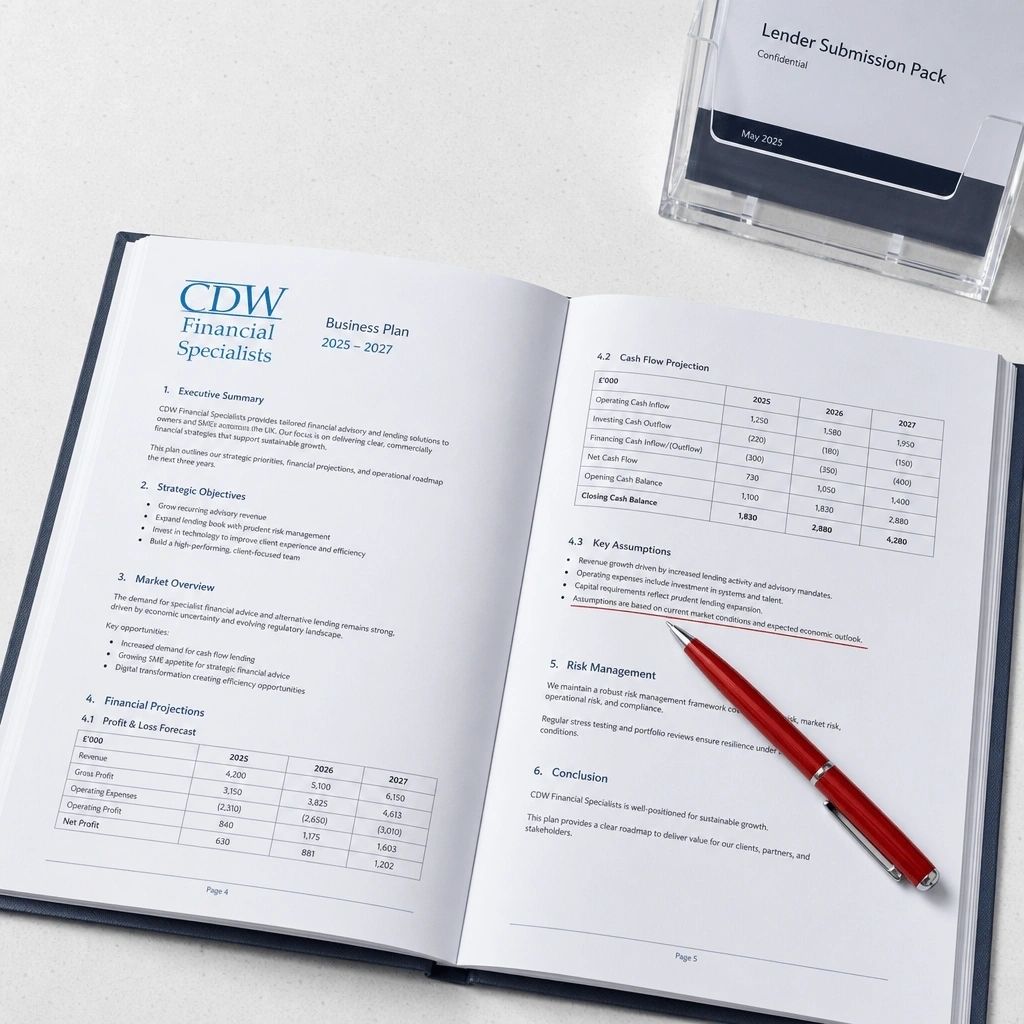
A clear executive summary should open the document and answer the core questions immediately: who you are, what you do, how much you need, what it’s for, and how you’ll repay it. Lenders read many applications and they often decide their initial position within the first page.
Detailed financial statements and forecasts should cover at least 24 months of cashflow projections alongside your profit and loss and balance sheet. If your business has existing financial challenges, include a separate section that explains the context, what happened, and what you’ve done or are doing about it.
Market evidence rather than market assumptions strengthens your projections considerably. Instead of stating that the market is growing, show data that supports it and connect that data to your specific revenue assumptions.
A management and operational section that demonstrates your team has the experience and structure to execute the plan is often underestimated in its importance. Lenders back people as much as they back ideas.
When Standard Lenders Aren’t the Right Fit
Here’s something the traditional lending process rarely acknowledges openly: not every business should be approaching high street banks, and not every funding need is best served by a conventional loan.
Businesses dealing with distress, cashflow difficulties, or complex financial histories often have more options than they realise, but those options tend to sit away from the mainstream. Specialist lenders operate with different criteria, different risk appetites, and different product structures that can work for circumstances that a high street bank would decline on the first page.
Some property funding solutions, for example, require no monthly repayments during the loan term, no income proof, no affordability assessments, and no credit searches. These exist because specialist lenders assess security and exit strategy differently to mainstream lenders. If you’ve been declined by a traditional bank, that rejection tells you about that specific lender’s criteria, not about your overall fundability.
The Value of Knowing Your Lender Panel
One of the most time-consuming and demoralising parts of seeking funding is approaching lenders one by one, getting rejections, and not fully understanding why. Each application takes time, each rejection can affect your credit profile, and the process pulls your focus away from running the business.
Working with a specialist commercial finance broker who maintains access to a broad panel of lenders means your application goes to the right lender from the start, positioned correctly for their specific criteria. That’s a fundamentally different experience from applying blind and hoping for the best.
We work across working capital, asset finance, property finance, and foreign exchange solutions, and our approach is built around understanding your specific circumstances before recommending any route. We also offer cashflow generation services that improve working capital without requiring any financial product at all, by reviewing aged debtors, creditors, and payment terms to unlock cash that’s already sitting in your business.
All fees are discussed upfront. There are no surprises, and we manage the entire process from initial consultation through to completion so you can stay focused on what you actually do.
If your business plan has been letting you down with lenders, or if you’re preparing to approach funding and want to get it right the first time, speak with us at CDW Financial Specialists and we’ll tell you exactly where you stand.